
The Kenya Revenue Authority (KRA) said on Tuesday it has raised the customs minimum valuation benchmark for general containerized consolidation cargo to 3.2 million Kenyan shillings ($24,800), from 2.5 million shillings, effective Aug. 20.
The tax authority said the revised customs benchmark follows consultations with the Kenya International Freight and Warehousing Association (KIFWA), small traders, cargo consolidators and other private-sector stakeholders, aimed at closing valuation loopholes exploited by some importers.
KRA said the previous benchmark of 2.5 million shillings had remained unchanged for about six years, despite an understanding reached with small traders that it would be reviewed upward after one year. It said the delay left the reference point out of step with rising import values and economic conditions.
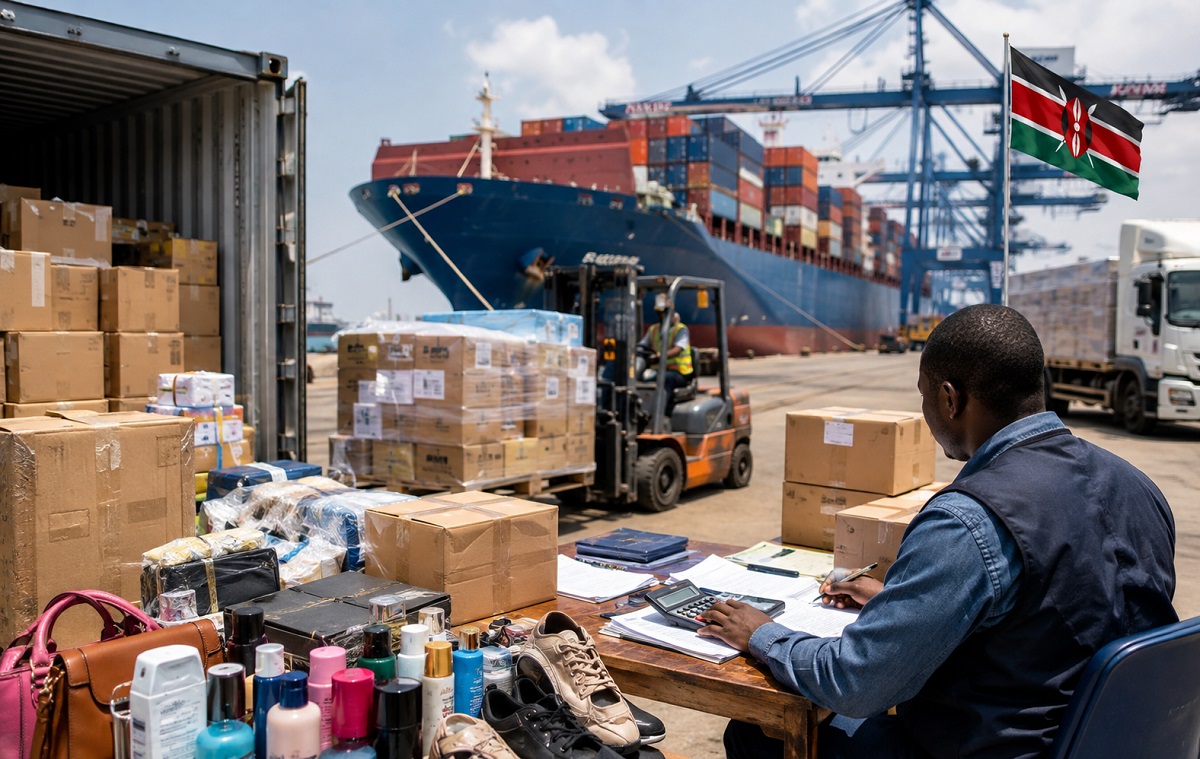
Cargo consolidation allows small traders to import goods by combining multiple shipments into a single container, lowering the cost of international trade. KRA said the practice has, in some cases, been exploited to facilitate undervaluation, under-declaration, misdescription, misclassification and concealment of high-value goods.
“This is not about targeting small traders. It is about creating a level playing field where businesses compete fairly,” KRA said in the media brief, adding that compliant traders should not be disadvantaged by others who evade customs obligations.
The authority said high-value electronics, including smartphones, are among the goods most commonly affected, with importers sometimes declaring high-end devices as lower-value models to reduce the customs value and taxes owed.
KRA also flagged concern over larger importers using consolidation arrangements, typically associated with small-scale trade, to lower their own tax obligations, which it said was distorting the business environment for compliant traders.
The tax authority stressed that the new 3.2 million shilling threshold is a minimum reference point, not a fixed valuation applied uniformly to every container. It said a single container could hold high-value electronics, machinery or specialized equipment worth significantly more than the benchmark figure.
“The KSh3.2 million benchmark does not mean that every container is valued at KSh3.2 million. If the actual value of the goods is higher, that value must be declared and the correct taxes paid,” KRA said, adding that the measure is intended to strengthen valuation controls rather than cap the value of imported goods.
Where the declared value of goods exceeds the benchmark, importers are required to make accurate declarations, and the shipment will be subject to the applicable customs valuation and tariff treatment, according to the brief.
KRA said the revised benchmark is also intended to protect local manufacturers, arguing that undervalued or inaccurately declared imports can enter the Kenyan market at artificially low costs, undercutting domestic producers who comply with tax and regulatory requirements.
“Fair competition requires businesses to compete on the basis of efficiency, quality and innovation, rather than through avoidance of taxes,” the authority said, adding that protecting the customs system also safeguards compliant businesses and supports local manufacturing.
KRA said the adjustment should not be characterized as a dispute between the authority and small traders, noting that most traders and consolidators comply with customs requirements and pay taxes due. It said its focus was on non-compliant practices that give some businesses an unfair cost advantage.
The authority also reminded traders that compliance obligations extend beyond the point of customs clearance. It said traders who go on to sell consolidated cargo in markets such as Eastleigh, Kamukunji, Nyamakima and Toy Market, among other commercial centers in Nairobi, must meet applicable domestic tax requirements.
Those obligations include proper business registration, electronic invoicing where applicable, and accurate declaration of income and taxes due, KRA said, urging traders to embrace compliance across the entire supply chain.
“Importing goods and paying customs taxes is only one part of compliance,” the authority said. “When the goods enter the domestic market and are sold, the trader must also meet the applicable tax obligations.”

Indumwa
Investreet Financial publishes financial education, market insights and practical resources to help readers make more informed financial decisions.