
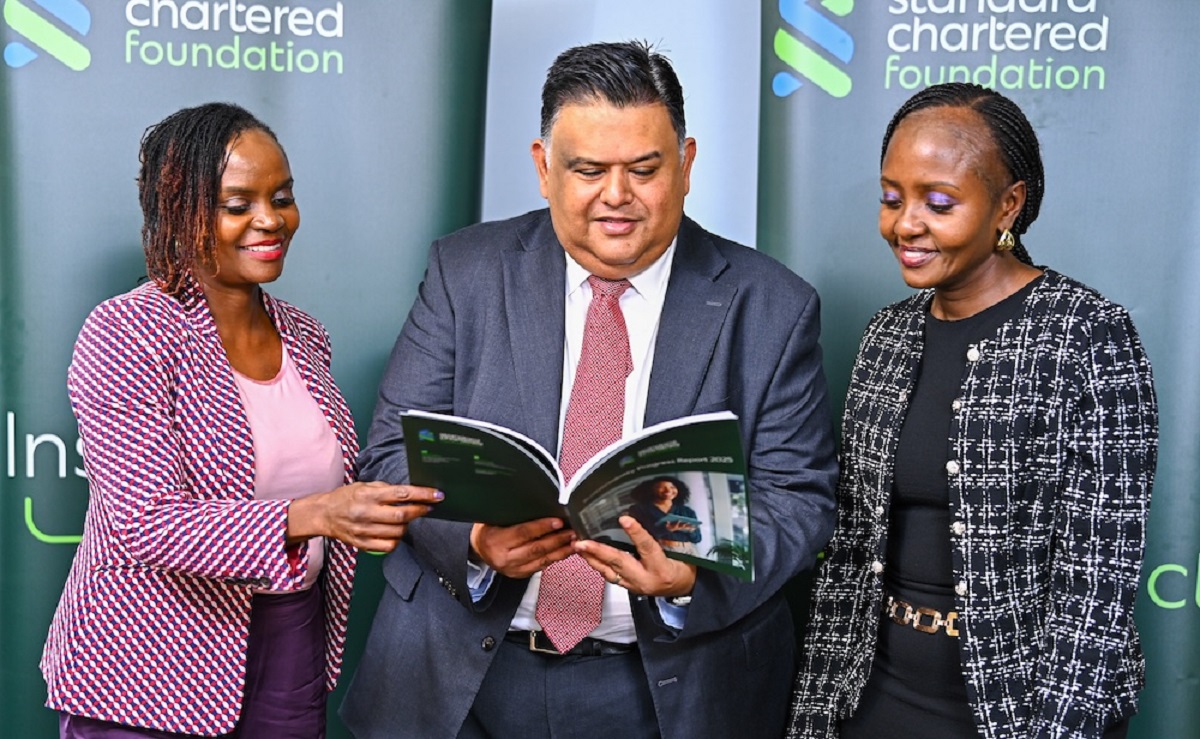
Standard Chartered Bank Kenya’s sustainable finance assets grew 11% to 62.5 billion Kenyan shillings ($484.5 million) in 2025, up from 56.2 billion shillings a year earlier, the lender said in its annual sustainability report.
Revenue from sustainable finance activities rose 16% to 3.5 billion shillings ($27.1 million), Standard Chartered Bank Kenya said in its 2025 Sustainability Progress Report, its fourth annual disclosure of environmental, social and governance financing figures.
The bank has generated 7.9 billion shillings ($61.2 million) in cumulative sustainable finance revenue since 2021, according to the report.
The figures underline how sustainable finance — lending and investment tied to green, social and climate-related activities — is becoming a mainstream part of Standard Chartered’s business in Kenya rather than a standalone corporate responsibility programme.
Standard Chartered Kenya’s sustainable finance assets increased as demand grew for financing linked to climate resilience, financial inclusion and long-term business growth, the bank said.
The bank’s Corporate and Investment Banking division accounted for most of the growth. Its sustainable finance revenue climbed 17% to 3.46 billion shillings in 2025 from 2.97 billion shillings in 2024, driven by sustainability-linked lending, green trade credit, transaction banking and advisory services, according to the report.
Transaction banking revenue within that division rose 15% to 3.22 billion shillings, while financial markets revenue linked to sustainability climbed 40% to 245 million shillings, the report showed. Income from the bank’s retail wealth and banking business, drawn from environmental, social and governance funds, fell 45% to 17 million shillings.
Assets held in the bank’s SC Shilingi Money Market Fund increased 47% to 27.8 billion shillings during the year, the report said.
Standard Chartered Kenya Chief Executive Officer and Head of Coverage Birju Sanghrajka said sustainability had moved from being a peripheral issue to a core driver of business growth.
“Sustainability is no longer a separate conversation from business growth,” Sanghrajka said, highlighting the bank’s strategy of integrating sustainable finance across lending, investment and advisory services.
“Our clients are increasingly looking for banking partners that can help them access capital, manage risk and build more resilient businesses in a rapidly changing operating environment,” Sanghrajka said. “Progress is measured not only by the capital we mobilise, but also by the opportunities we help create,” he said.
Standard Chartered Bank Kenya has mobilised more than 97 billion shillings in sustainable finance since 2021, supporting renewable energy, affordable housing, sustainable infrastructure and women-led businesses, the bank said. “Our ambition remains to be the leading cross-border bank connecting capital with sustainable growth opportunities in Kenya and beyond,” the bank said.
The bank said its sustainability criteria are aligned with two frameworks: a Green and Sustainable Product Framework and a Transition Finance Framework, which set out the standards clients must meet to be classified as green, social or transition-linked borrowers.
The bank said sustainability is now embedded in its lending decisions through alignment with the Central Bank of Kenya’s Green Finance Taxonomy and Climate Risk Disclosure Framework, which requires lenders to incorporate climate-related risks into credit assessments.
During 2025, Standard Chartered assessed 21 large corporate clients under its climate risk framework, representing about 19% of its Corporate and Investment Banking portfolio, and none of the assessed clients fell into the highest climate-risk categories.
The bank’s Women International Network programme, which finances women-led businesses, grew to support 491 entrepreneurs with a combined 2.9 billion shillings in assets under management, up from 2.6 billion shillings a year earlier, according to the report.
Investors under the age of 40 made up 62% of clients on the bank’s digital investment platforms, while women accounted for 49% of its investor base.
The bank also reported progress in reducing its own environmental footprint, with Scope 1 and Scope 2 greenhouse gas emissions from its Kenyan operations falling 9.7% during the year, alongside declines in energy consumption, water use and waste sent to landfill. The bank said it recycled nearly 68 tonnes of waste, achieving an 84% landfill diversion rate.
The Standard Chartered Nairobi Marathon, one of the bank’s flagship community events, attracted 30,668 participants in 2025 and raised 76.3 million shillings for foundation programmes, while distributing 10,000 tree seedlings and 30,000 seedballs, according to the report.
Employees contributed 4,039 hours of skills-based volunteering during the year, with 87% of staff taking part in company initiatives.
The report comes as Kenyan regulators tighten expectations around sustainability disclosure in the banking sector.
The Central Bank of Kenya released the Kenya Green Finance Taxonomy and Climate Risk Disclosure Framework for implementation by the banking sector, intended to help market participants classify economic activities as green or environmentally sustainable and to promote the transition to a low-carbon economy.
The taxonomy provides a classification system for identifying environmentally sustainable economic activities, while the disclosure framework guides financial institutions on how to report and manage climate-related risks, with implementation beginning on a voluntary basis in April 2025.
The Kenya Bankers Association, the industry’s umbrella body, has also adopted its own Sustainable Finance Guiding Principles, developed with support from the International Finance Corporation, to help banks integrate environmental, social and governance considerations into their operations.
A related industry landscape report found gross loans across 11 key sectors grew 23% since 2020, reaching 3.6 trillion shillings in 2022, with small and medium-sized enterprises receiving 783.3 billion shillings.

Indumwa
Investreet Financial publishes financial education, market insights and practical resources to help readers make more informed financial decisions.