
The Nairobi Securities Exchange (NSE) reported a 386% jump in first-half profit to 736.9 million shillings ($5.7 million) for the six months ended June 30, 2026, up from 151.6 million shillings a year earlier, the bourse operator said in unaudited results published Thursday.
The results, approved by the NSE board on Aug. 27, showed total income more than doubled to 1.21 billion shillings from 511.6 million shillings in the same period of 2025, as trading activity across equities, fixed income and derivatives markets picked up.
Earnings per share rose to 2.82 shillings from 0.58 shillings, while total comprehensive income for the period reached 1.03 billion shillings, compared with 171.9 million shillings a year earlier, according to the exchange’s financial statements.
The Nairobi bourse said the growth in profitability was driven largely by its equities business, where transaction levy income rose 476% to 770.5 million shillings, boosted by increased participation from domestic and foreign investors and a large block trade in telecoms operator Safaricom.
Equity market turnover climbed 476% to 322 billion shillings in the first half of 2026, from 56 billion shillings in the same period last year, the exchange said, describing it as the strongest performance in several years.
Trading was lifted by a block transaction involving 6.01 billion Safaricom shares valued at 204.3 billion shillings, the NSE said. Excluding that single trade, equity turnover still rose 111% year-on-year, it added.
The exchange’s fixed-income segment also expanded, with bond market turnover up 22% to 1.39 trillion shillings, supported by higher secondary market activity and increased government bond reopenings, the NSE said.
Derivatives turnover rose 1,774% to 637 million shillings, which the exchange attributed to stronger retail participation and a reduction in contract sizes for single-stock futures.
Data income, generated from the sale of market information, grew 29% to 75.2 million shillings from 58.2 million shillings, the exchange said.
All of the NSE’s benchmark indices recorded double-digit gains in the first half of the year. The NSE All Share Index rose 20.14% to close at 224.15 points, while the NSE 20 Share Index gained 19.63% to 3,755.44 points, the exchange said.
The NSE 10 Share Index and NSE 25 Share Index advanced 22.61% and 21.82%, respectively, ending the period at 2,409.62 and 6,208.91 points.
Total assets stood at 3.62 billion shillings as of June 30, 2026, up from 2.30 billion shillings a year earlier, while shareholders’ equity rose to 2.87 billion shillings from 2.06 billion shillings, the financial statements showed.
The exchange said its annualised return on equity improved to 51.5% from 14.8%, and annualised return on assets rose to 40.7% from 13.2%, over the same comparative period.
The board did not declare an interim dividend for the six months ended June 30, 2026, the NSE said.
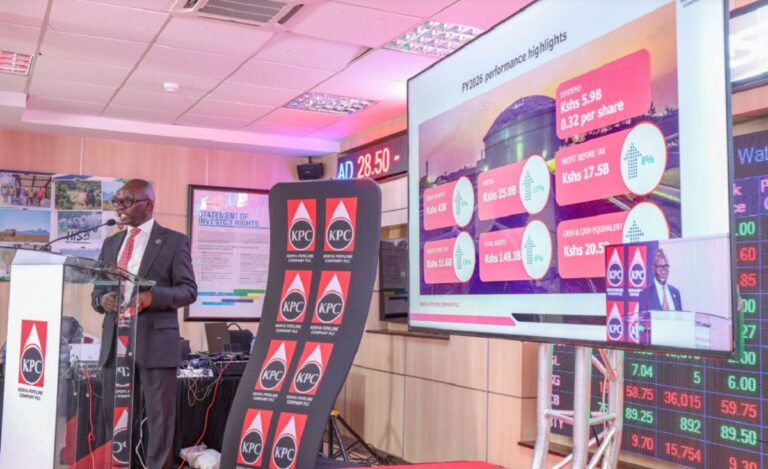
The period also marked a revival in listing activity on the Nairobi bourse. The listing of Kenya Pipeline Company ended what the exchange described as an initial public offering drought of more than a decade.
The NSE also listed the TRIFIC USD-Denominated Real Estate Investment Trust, expanding the range of investment products available to investors, as well as the KMRC Bond and the I&M Bond.
Kenya’s economy remained resilient in the first half of 2026, with the International Monetary Fund projecting 4.5% growth for the year, supported by the services and industrial sectors, the exchange said, citing stable agricultural output and improving private-sector credit.
The Central Bank of Kenya held its benchmark lending rate at 8.75% during the period, pausing an easing cycle as it sought to balance support for economic activity against the risk of imported inflation, according to the NSE. Commercial lending rates declined to 14.5% by mid-2026, it said.
The Kenyan shilling traded in a stable range of 129 to 130 against the U.S. dollar, while inflation rose to 4.5% by mid-year, remaining within the central bank’s target range, the exchange said.
The NSE said it would focus in the second half of 2026 on strengthening market infrastructure and expanding listings across equity and debt markets under its 2025-2029 strategy.
A key priority is the rollout of a new integrated market infrastructure system intended to upgrade the exchange’s technology, improve market efficiency and support new products, the NSE said.
The exchange said it continues to engage prospective issuers across “priority sectors” as part of efforts to broaden Kenya’s capital markets and support privatisation, infrastructure financing and financial inclusion.

Indumwa
Investreet Financial publishes financial education, market insights and practical resources to help readers make more informed financial decisions.