

 By
Kenyan business leaders called on Tuesday for stronger institutional trust to lower the cost of doing business, at a roundtable in Nairobi held two months before the country hosts the inaugural Global Trust Summit in October.
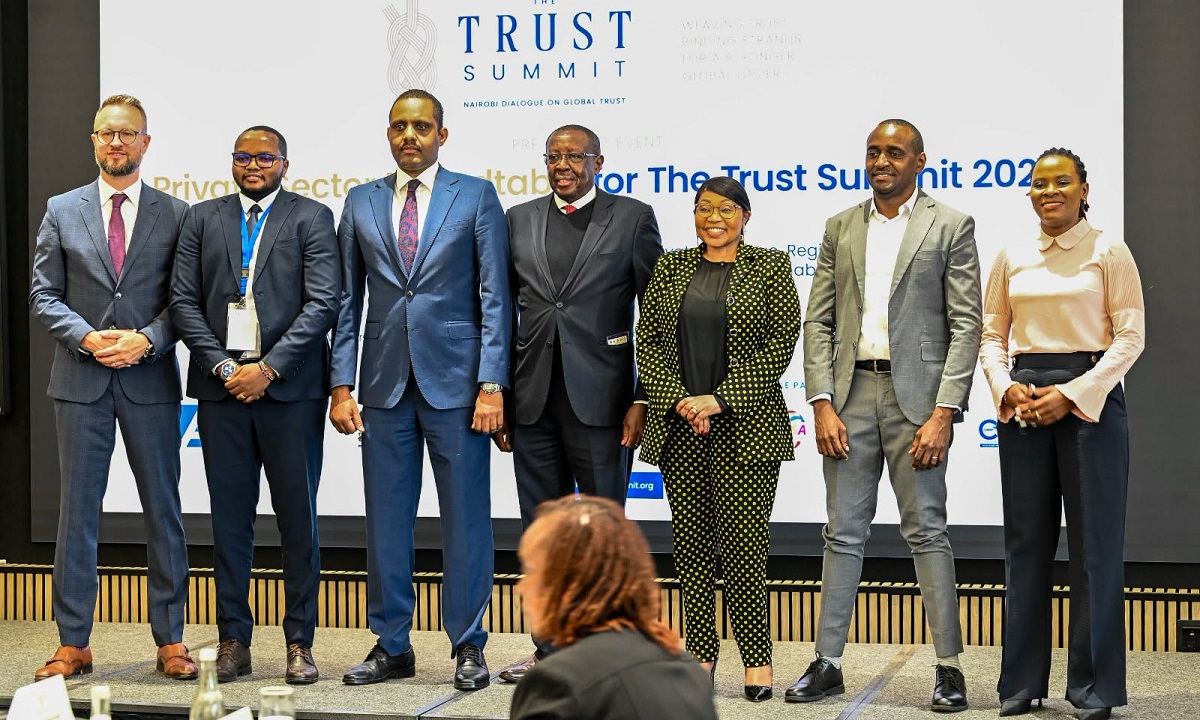
The Private Sector Roundtable, themed “Trust as an Economic Asset,” brought together representatives of government, business associations and development organisations to discuss how institutional confidence affects investment, trade and market resilience.
Kenya is scheduled to host the Global Trust Summit in Nairobi from October 22 to 23, bringing together governments, regulators, businesses and civil society groups to address what organisers describe as a global decline in public trust.
Speaking on behalf of Foreign Affairs Principal Secretary Korir Sing’Oei, Mustafa Ibrahim, deputy director-general at the State Department for Foreign Affairs, told the roundtable that trust should be treated as an economic asset that influences investment, access to finance and Kenya’s competitiveness.
“Confidence in institutions has come under strain, economic uncertainty has risen, geopolitical tensions persist, and rapid technological change is reshaping how governments, businesses and citizens interact,” Ibrahim said.
He said building trust required a stable, predictable policy environment from government, alongside responsible corporate governance from the private sector.
Xn Iraki, a professor at the University of Nairobi’s Faculty of Business and Management Science, said weak trust directly raises costs for companies and investors.
“When people trust each other, businesses spend less on contracts, audits, and security, and can charge more without losing customers,” Iraki told the gathering, adding that eroded trust leads to higher interest rates and more red tape.
Mathias Kamp, country director for the Konrad-Adenauer-Stiftung’s Kenya office and a co-convener of the Trust Summit, said infrastructure investment could not deliver its intended benefits without trusted institutions and businesses to support it.
Lucy Muchoki, partnership director at the Kenya National Chamber of Commerce and Industry, said the discussion needed to move from acknowledging that trust matters to identifying concrete reforms.
“Trust is not simply about reputation; it has direct economic value,” Muchoki said, calling for stakeholders to agree on the partnerships needed to strengthen it.
The roundtable was organised in partnership with the Kenya Private Sector Alliance, the Konrad-Adenauer-Stiftung, the Institute of Public Finance, the Kenya National Chamber of Commerce and Industry, TradeMark Africa and the COMESA Business Council.
It formed part of preparations for the Global Trust Summit, which is convened under the theme “Weaving Trust: Binding Strands for a Stronger Global Order.”
Organisers cite the 2025 Edelman Trust Barometer, which found global trust in government stood at 52%, compared with 62% for business, making business the only major institution surveyed that respondents viewed as both competent and ethical.
The summit’s concept note says low-income countries receive less than 1% of global foreign direct investment despite significant capital needs, and that African nations pay an estimated $75 billion a year in additional interest costs tied to perceived institutional risk.
Organisers say the summit is intended to contribute to the United Nations’ 2024 Pact for the Future, which commits member states to rebuilding trust in global institutions.
The Global Trust Summit is expected to produce several concrete outputs, according to organisers. These include a Nairobi Statement on Global Trust for Sustainable Development and Peace, setting out areas of consensus reached at the summit, and a Trust Barometer, described as a public dashboard tracking trust levels over time.
Organisers also plan to establish a Trust Summit Secretariat to monitor and report publicly on progress against commitments made at the event, along with a report on Africa’s trust landscape and policy recommendations with time-bound commitments across the summit’s thematic areas.
Those areas include international cooperation, democratic governance, trust as an economic asset, and information integrity in the digital age.
Kenyan officials have separately been engaging domestic regulators ahead of the summit. Prime Cabinet Secretary Musalia Mudavadi told a meeting of more than 20 regulatory agencies this month that trust was the foundation of strong institutions, resilient democracies and prosperous economies, and urged agencies to identify measurable reforms before October.
Organisers say the Nairobi summit is also expected to draw thousands of delegates, providing a boost to the city’s hotel, transport and hospitality sectors.
The Global Trust Summit follows a series of preparatory events, including engagement with regulators and private sector groups, as Kenya positions itself as a venue for international dialogue on governance and institutional trust.