
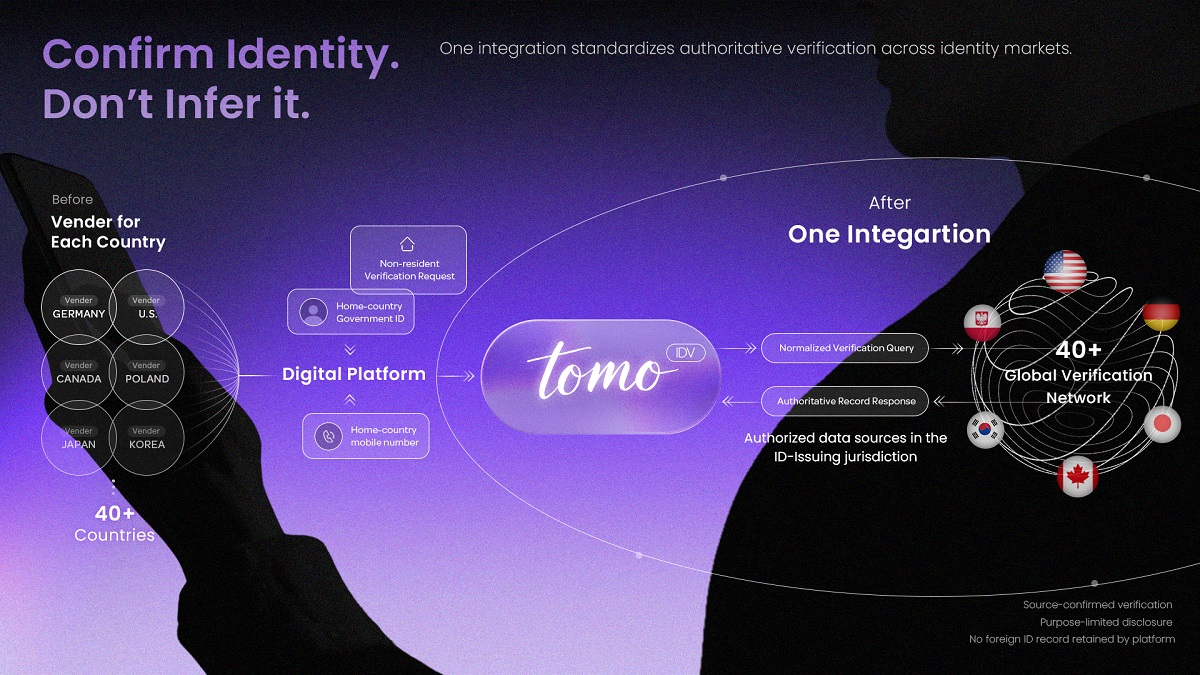
South Korean financial technology and regulatory technology company Tomoarrow said it has launched an electronic identity verification system designed to let international users confirm their identities without locally issued documents.
The product, called TomoIDV, is aimed at businesses that need to verify customers who live, work, study or travel outside their home countries, the company said in a statement.
TomoIDV generates what Tomoarrow calls a client-specific Pseudonymous Permanent Identifier, or PPID, for each user.
The identifier lets a business recognize a returning customer across multiple interactions while limiting how much of that customer’s underlying personal data the business has to store or handle directly, according to the company.
To verify a user, the system draws on identity documents issued in the person’s home country, along with mobile phone numbers, selfie photographs and liveness checks that confirm a live person, rather than a photograph or video, is completing the process.
Where available, TomoIDV also cross-references authoritative data sources in the user’s home country, Tomoarrow said.
The company said the tool is delivered through a single application programming interface, or API, that supports verification workflows tailored to individual countries.
Businesses can combine basic and enhanced checks depending on the type of service being offered, applicable regulatory requirements, and the level of risk associated with a given transaction, according to Tomoarrow.
The platform also allows companies to retrieve results from earlier verifications and to trigger a new check when a customer’s information changes or when additional assurance is needed, the company said.
Tomoarrow said the launch responds to a growing gap in digital identity verification systems, most of which were built primarily with domestic residents in mind.
As more people relocate, travel or work abroad for extended periods, the company said, those systems have struggled to accommodate customers who do not hold identity documents or mobile accounts issued in the country where they are seeking a service.
That gap can leave international users unable to access basic services including housing rentals, telecommunications contracts, financial products and transportation or mobility platforms, according to Tomoarrow.
For companies offering those services, the challenge cuts both ways, the company said. Verification requirements that are too weak can leave a business exposed to identity theft, fraudulent accounts, payment fraud, chargebacks and money laundering.
Requirements that are too strict, meanwhile, risk shutting out legitimate customers who simply lack the credentials a domestic system expects, Tomoarrow said.
By folding international customers into a single verification process rather than building separate systems for each market, Tomoarrow said businesses can extend cross-border identity verification to a wider customer base without developing country-specific compliance infrastructure from scratch.
Tomoarrow described TomoIDV as serving two purposes: helping businesses meet compliance and risk-management obligations under anti-money laundering and know-your-customer, or eKYC, rules, while also widening access to digital services for groups that often fall outside conventional verification systems.
Those groups include tourists, international students, migrant workers, remote professionals and other cross-border consumers. Tomoarrow, which describes itself as a fintech and regtech firm, is based in South Korea.
The launch comes amid broader efforts across the financial technology and regulatory technology sectors to strengthen identity verification as international travel, migration and remote work continue to rise.
Digital identity and eKYC tools have become a focus for regulators and financial institutions seeking to balance fraud prevention with customer access, particularly as cross-border payments and services expand.

Indumwa
Investreet Financial publishes financial education, market insights and practical resources to help readers make more informed financial decisions.