
 By
By AFRICLOUD has opened a cloud infrastructure region in Lagos, Nigeria, expanding its African footprint while offering local payment options across a growing number of African markets.
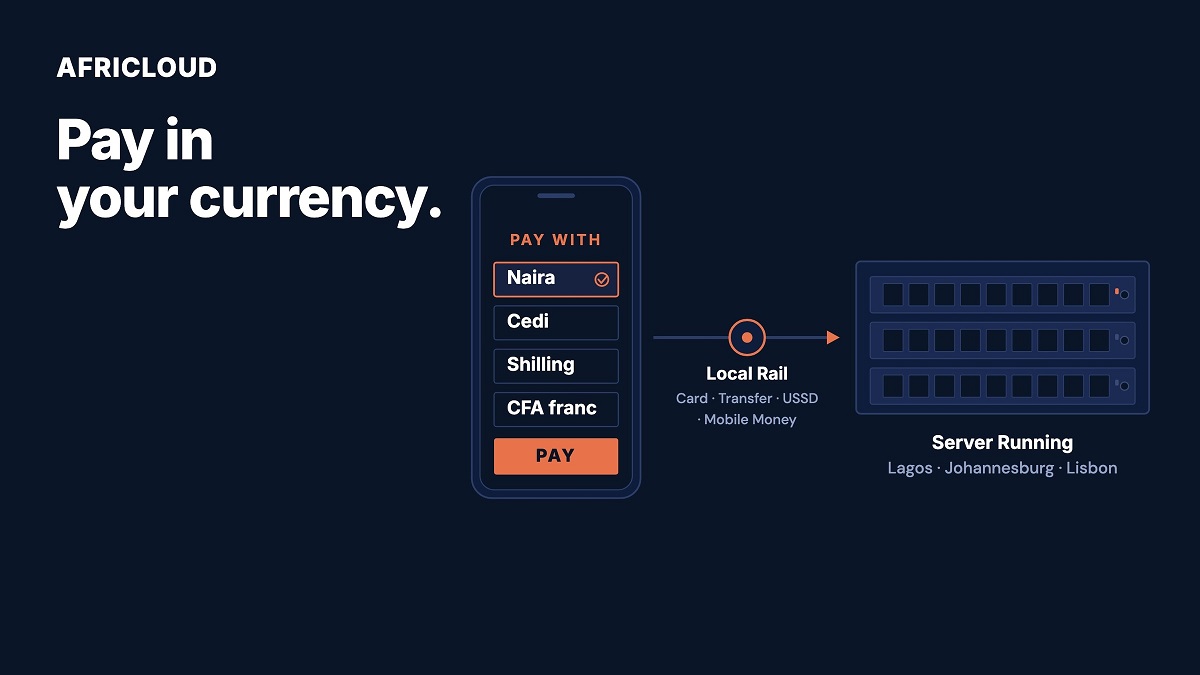
The AFRICLOUD Lagos region is the company’s third infrastructure location, alongside facilities in Lisbon, Portugal, and Johannesburg, South Africa. The company says the Lagos deployment allows Nigerian customers to run cloud workloads inside the country.
The move comes as African businesses and developers increasingly seek cloud infrastructure closer to their customers and payment systems that do not depend exclusively on international cards or foreign-currency transactions.
AFRICLOUD, which describes itself as a cloud infrastructure provider, said its Lagos servers are hosted in a carrier-neutral data centre in Lagos. The company offers cloud computing, storage and networking services through the same account and dashboard used across its other regions.
The AFRICLOUD Lagos region joins the company’s existing infrastructure in Lisbon and Johannesburg.
According to AFRICLOUD, the Lagos location provides in-country cloud computing and storage for Nigerian customers. The company said storage and backups can remain in Nigeria, giving organisations a local hosting option where data-residency requirements are relevant.
AFRICLOUD’s published network information shows the Lagos region is connected to Nigeria’s internet infrastructure and submarine cable systems, including Equiano, MainOne, WACS, 2Africa and ACE. The company also says it peers locally through the Internet Exchange Point of Nigeria.
The provider’s own measurements show very low round-trip latency from Lagos to several Nigerian cities. It reports best-case measurements of about 0.1 milliseconds within Lagos, 0.4 milliseconds to Ikeja, 1.8 milliseconds to Ibadan and 9.9 milliseconds to Abuja, although AFRICLOUD cautions that real-world latency can be higher.
For businesses operating applications where response times matter, hosting workloads closer to end users can reduce the network distance between the application and its customers.
The Lagos launch also creates a third jurisdiction for organisations using AFRICLOUD.
Its Lisbon region provides infrastructure under European Union jurisdiction, while Johannesburg serves customers from South Africa. Lagos gives customers the option of keeping Nigerian workloads in Nigeria while using the same platform for infrastructure elsewhere.
AFRICLOUD says its cloud servers use AMD EPYC processors and NVMe storage. The platform also provides IPv4 and IPv6 connectivity, automated backups, block storage, floating IP addresses and an application programming interface, or API, for developers.
The company says customers can provision cloud servers through its self-service platform rather than requiring a separate sales process for standard deployments.
Alongside the Lagos expansion, AFRICLOUD has been expanding payment options for African customers.
The company introduced mobile-money checkout in 11 African markets in April, allowing customers to fund their cloud accounts using local mobile-money wallets.
The initial markets included Benin, Cameroon, Republic of Congo, Democratic Republic of Congo, Côte d’Ivoire, Gabon, Rwanda, Senegal, Sierra Leone, Uganda and Zambia.
AFRICLOUD says customers in those markets can select their local mobile-money option at checkout and approve the transaction through their phones.
The payment is made in local currency, with the amount converted to the billing currency used on the customer’s account.
The company’s current documentation says local payment options are also available in Nigeria, Ghana, Kenya, South Africa and other supported markets, depending on the payment methods available to customers in each country.
AFRICLOUD accepts several other payment methods, including credit and debit cards, PayPal and more than 300 cryptocurrencies. Its current documentation lists billing currencies including U.S. dollars, euros, British pounds, South African rand and Nigerian naira.
The expansion comes against a backdrop of widespread mobile-money use across sub-Saharan Africa.
AFRICLOUD cited figures from the GSMA’s State of the Industry Report on Mobile Money 2024, which found that sub-Saharan Africa accounted for $1.1 trillion in mobile-money transaction value in 2024, or about 65% of the global total.
The development of local payment infrastructure has become increasingly important for digital businesses operating across African markets, where access to international cards, foreign exchange and cross-border payment services varies significantly between countries.
The Lagos deployment also gives AFRICLOUD a base from which to serve parts of West and Central Africa.
The company says its three-region network now provides access to 42 African countries within measured local-grade round-trip times, although those figures are based on AFRICLOUD’s own network measurements rather than an independent industry benchmark.
AFRICLOUD’s strategy differs from that of much larger global cloud providers by focusing on infrastructure in selected African markets and payment methods such as mobile money and cryptocurrency.
Its current infrastructure footprint remains considerably smaller than those of global hyperscale cloud providers, which operate substantially larger networks and broader portfolios of cloud services.
The Lagos launch therefore represents an expansion of regional infrastructure rather than a shift in the overall structure of Africa’s cloud-computing market.