

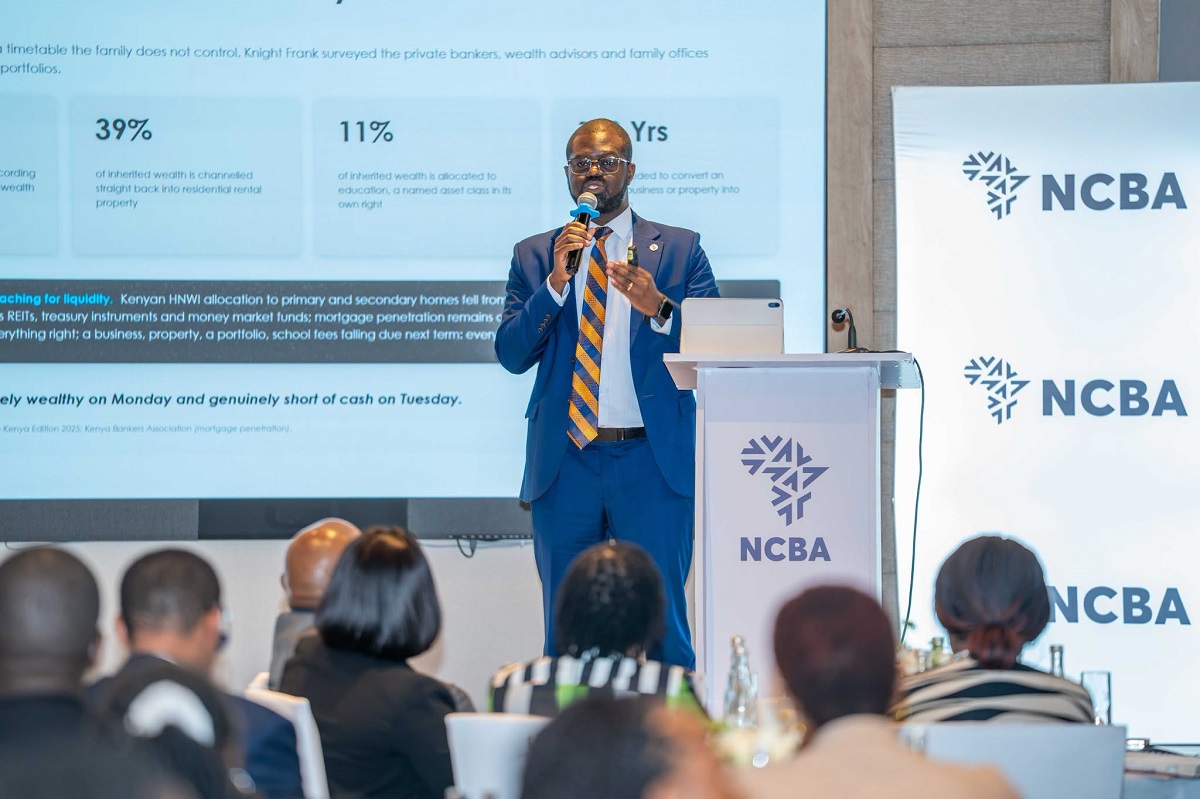
NCBA Group, one of Kenya’s largest lenders, brought together business families, entrepreneurs and legal advisers this week to discuss succession planning and estate management, as advisers warn that poor preparation is putting billions of shillings in family wealth at risk.
The event, called the NCBA Intergenerational Wealth Governance and Succession Forum, focused on how families can transfer businesses and assets to the next generation without triggering the disputes that have tied up thousands of estates in Kenyan courts.
“Every successful enterprise eventually reaches a point where the conversation must evolve from how wealth is created to how it is preserved, protected and passed on,” John Gachora, NCBA Group Managing Director, told the forum. “This transition is happening now, and families need to prepare for it.”
Succession planning in Kenya has become a pressing concern for wealthy families and business owners as a large generational transfer of assets approaches. Kenya has close to 500 family-owned businesses generating more than $10 million in annual revenue, according to research by data firm Asoko, with about 15% of those earning above $50 million a year.
Separately, industry estimates presented at a recent Nairobi conference put the number of shilling millionaires in Kenya at between 880,600 and 932,400, controlling roughly 11.7 trillion shillings ($90 billion) in assets, much of it tied up in family businesses, according to a report by Capital FM.
Across Africa, an estimated 323.7 trillion shillings in investable wealth is expected to pass to a new generation in coming years, the report said.
Advisers say the absence of clear succession and estate plans is already causing costly disputes. Kenya’s judiciary has reported that more than 13,000 succession cases remain pending in Nairobi courts alone, with some disputes running for decades, according to legal firm McKay Advocates.
The firm cited the case of former Cabinet Minister Mbiyu Koinange, who died intestate in 1981 leaving four widows and 18 children; his estate has generated more than 50 parallel lawsuits over more than 40 years.
It also pointed to an estate dispute involving the late Nyeri Governor Nderitu Gachagua that has resurfaced despite the existence of a will, illustrating that even documented plans can face legal challenges once they enter the succession court process.
The NCBA forum addressed succession, estate planning, governance structures, investment strategy, tax planning and preparing younger family members to take on financial responsibility, the bank said.
Sessions were led jointly with law firm Bowmans and Strategic Consultants Ltd, who advised on legal structures, governance frameworks and the mechanics of transferring family wealth between generations.
Kenya’s Law of Succession Act, known as Cap 160, is the primary legal framework governing inheritance in the country, setting out rules for both “testate” succession, where a person leaves a valid will, and “intestate” succession, where no will exists and courts distribute the estate.
Legal advisers say that without a will or a trust structure, estates are more likely to face court proceedings, delays and disputes among heirs.
Family trusts have become a more commonly recommended tool among Kenyan advisers because trust assets, unlike those held directly by an individual, generally do not have to pass through the succession court process, according to McKay Advocates. Advisers say this can reduce the risk of prolonged litigation after a family member’s death.
Wealth managers also point to communication gaps, rather than financial mismanagement, as a leading cause of failed wealth transitions. Research cited by legal advisory firm WAREN Law Advocates found that 97% of wealth transition failures were linked to breakdowns in family communication and unprepared heirs, rather than financial losses.
Alongside the succession and estate planning discussions, NCBA customers at the forum were shown the bank’s investment and insurance products, as well as its Visa Infinite Card, which offers airport lounge access, round-the-clock concierge services, multi-trip travel insurance and access to the Visa Luxury Hotel Collection, the bank said.
NCBA said it aims to act as a long-term partner for families beyond the point at which wealth is first accumulated, supporting clients as assets are structured, protected and passed on.
The forum reflects a wider push among Kenyan banks, law firms and wealth managers to encourage earlier estate planning, as courts continue to grapple with a backlog of succession cases.
Legal experts say that structured planning, including wills, trusts and shareholder agreements for family businesses, remains the most reliable way to avoid the kind of prolonged disputes that have affected prominent Kenyan estates in recent years.

Indumwa
Investreet Financial publishes financial education, market insights and practical resources to help readers make more informed financial decisions.