

British companies are set to secure more than £330 million in contracts linked to nine infrastructure projects in Guinea and Benin, supported by £1.1 billion in financing and guarantees from UK Export Finance, the British government said on October 20.
The projects cover education, clean water, electricity transmission and government facilities, as the United Kingdom expands its export financing capacity across West and Central Africa.
UK Export Finance (UKEF), the government’s export credit agency, is also increasing its exposure capacity across the region by £1.7 billion, giving it greater scope to support future projects involving British exporters.
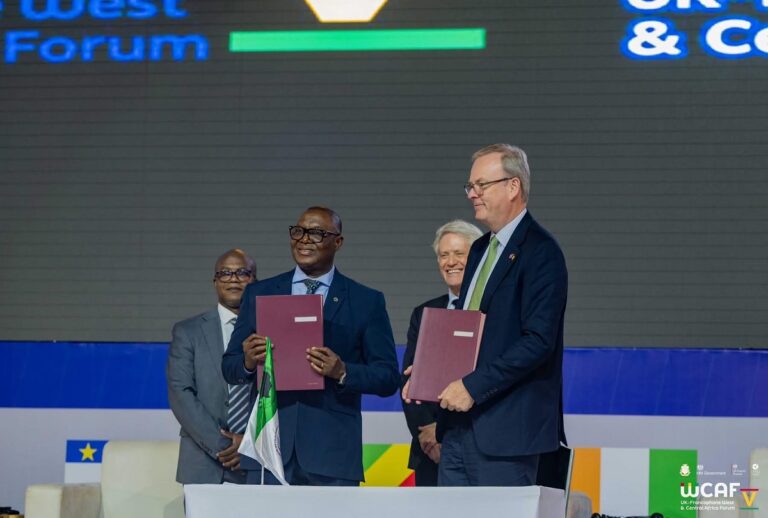
The announcement coincided with the opening of the fifth UK-West and Central Francophone Africa Trade and Investment Forum in Conakry, Guinea. The event brings together British businesses and prospective partners from across the region.
Business and Trade Secretary Jonathan Reynolds said the contracts would help British companies enter growing markets, supporting employment and economic activity in the United Kingdom while strengthening commercial relationships with African countries.
“These deals are a major win for UK businesses,” Reynolds said, adding that government-backed export finance was helping companies secure overseas work.
Education and water projects receive funding
One of the projects involves a £75 million financing package for an education infrastructure programme covering four regions in Guinea.
According to the government announcement, UK company Planet One secured the contract to deliver new primary and secondary schools. The programme is intended to expand access to education through additional classrooms, sanitation facilities and related infrastructure.
A separate £91 million financing package will support the Guinea Regional Water Project, which aims to expand access to safe drinking water through new treatment and distribution infrastructure.
UK-headquartered Aqua Africa is delivering the project. The company has previously secured UKEF-backed financing for water infrastructure in the region, according to the government.
Access to reliable water supplies remains an important infrastructure priority for countries seeking to improve public services and support urban and regional development. The announcement, however, did not specify how many additional households would receive water under the new programme or when the facilities would become operational.
Electricity transmission and government buildings
UKEF is also providing £129 million towards the La Cotiere Conakry Transmission project in Guinea, which forms part of a wider programme to improve electricity distribution along the country’s coastal region.
The contract was secured by Elecnor. The project is expected to create opportunities for British suppliers of transmission equipment, grid technology and engineering services.
Reliable electricity infrastructure is essential to supporting businesses, public services and industrial activity. The announcement did not disclose the project’s expected capacity, construction schedule or the number of people likely to benefit.
In neighbouring Benin, UKEF is providing £82 million in financing to support a new government administrative complex.
The contract was awarded to ACC UK Group Ltd. British companies could supply design and engineering services, security systems and specialist building services for the development.
The complex is intended to consolidate public services within a modern urban development. The government announcement did not specify a completion date or provide further details on the project’s planned facilities.
The four financing packages account for £377 million of the £1.1 billion in financing and guarantees announced for the wider programme. The government said the contracts would form part of nine major infrastructure projects across the two countries.
UK expands export finance capacity
The additional £1.7 billion in UKEF exposure capacity is intended to enable further support for British exporters seeking contracts in West and Central Africa.
Export credit agencies help domestic companies compete for international business by providing financing, guarantees or insurance that can reduce payment and lending risks associated with overseas projects.
In infrastructure deals, this support can help foreign buyers obtain financing while enabling exporters to supply equipment, technology and professional services.
UKEF Chief Executive Tim Reid said British businesses had secured contracts across the region in recent years, supporting jobs in the United Kingdom while helping African partners develop infrastructure.
The agency’s role is particularly relevant to large projects that require substantial upfront financing and involve several contractors, suppliers and lenders.
However, the additional exposure capacity is not the same as money already disbursed. The announcement did not set out how quickly the expanded capacity would be used or how much additional financing would ultimately be approved for individual projects.
Trade ties with Francophone Africa
The contracts were announced as government officials, businesses and financiers gathered in Conakry for the fifth UK-West and Central Francophone Africa Trade and Investment Forum.
The event is hosted by UKEF in partnership with DMA Invest and the Guinean government. It ran through October 21, according to the announcement.
Atam Sandhu, chief executive of DMA Invest, said the forum was intended to bring governments, businesses and financiers together to move priority projects from discussions towards implementation.
The latest deals build on earlier UK-backed infrastructure financing in the region, including projects in Benin and Togo announced in 2022. Those arrangements supported construction activity and created opportunities for British suppliers.
The new contracts reflect an approach in which export financing is used to connect infrastructure development in overseas markets with commercial opportunities for companies in the United Kingdom.

Indumwa
Investreet Financial publishes financial education, market insights and practical resources to help readers make more informed financial decisions.