

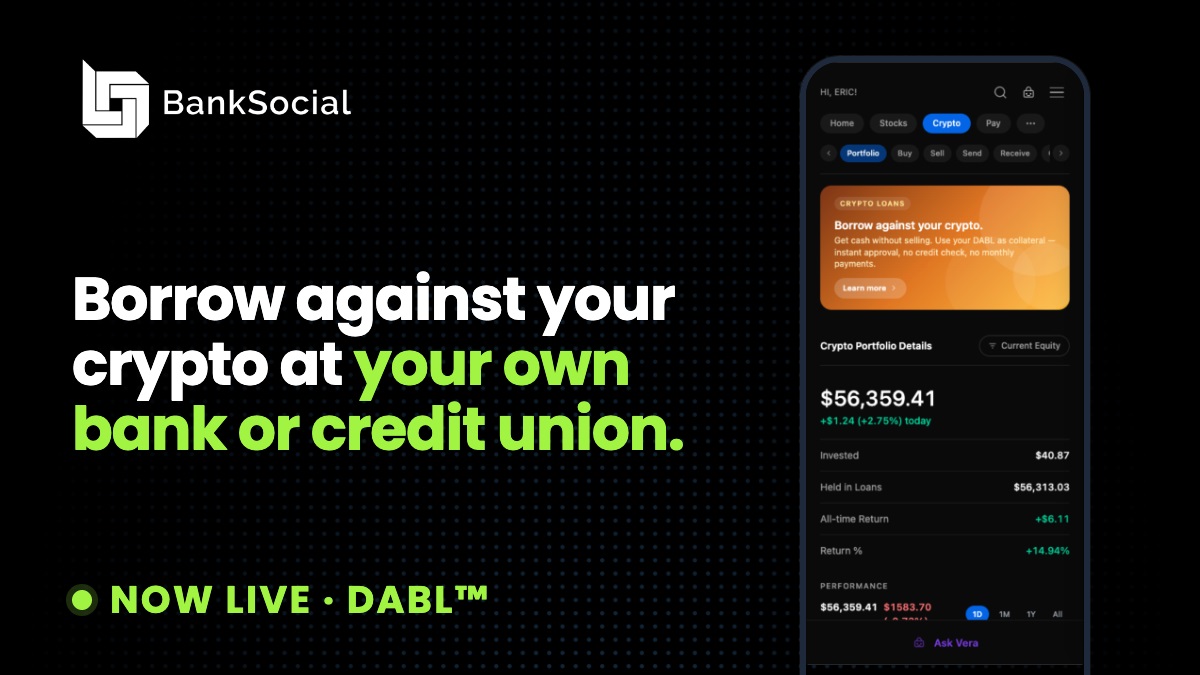
Dallas-based financial technology company BankSocial has launched a platform for crypto-backed loans at a U.S. financial institution, with the unnamed lender originating nearly $1 million in loans during the first 48 hours, the company said on October 19.
The platform, called Digital Asset-Backed Loans (DABL), allows participating banks and credit unions to lend against eligible cryptocurrencies through their existing digital banking services, giving customers a way to access credit without first selling their holdings, according to BankSocial.
The launch marks an expansion of cryptocurrency-backed lending into conventional banking channels, although the scale of broader consumer demand and the commercial performance of the service remain unclear.
BankSocial said the platform was operating at a financial institution with assets worth several billion dollars. It has not yet publicly identified the launch partner, saying it expects to announce the institution and additional participants during the fourth quarter of 2026.
Banks retain control over lending decisions
Under the DABL model, BankSocial provides the technology connecting a lender’s core banking system, mobile and online banking channels, and digital-asset custodian. The participating institution makes the credit decision, originates the loan and remains responsible for servicing it.
Banks and credit unions can determine which cryptocurrencies they accept as collateral and establish their own interest rates, loan-to-value limits, underwriting standards and liquidation thresholds, BankSocial said. The platform supports more than 250 digital assets, subject to each institution’s eligibility rules.
Eligible collateral may include Bitcoin, Ethereum, Solana, Chainlink, Hedera and XRP, the company said.
The approach differs from services in which a customer is directed to an external cryptocurrency lender. Under DABL, the participating institution retains ownership of the lending relationship and the loan, potentially creating an additional source of interest and fee income.
John Wingate, BankSocial’s founder and chief executive, said the early lending volume indicated that customers wanted access to digital-asset borrowing through institutions they already used.
The nearly $1 million figure was provided by BankSocial. The company has not disclosed the number of loans, average loan size, interest rates, borrower profiles or the independent verification available for the reported volume.
Borrowers can access loans through banking apps
The platform is designed to integrate cryptocurrency-backed borrowing into customers’ existing mobile and online banking experiences, rather than requiring them to navigate a separate lending application.
According to BankSocial, borrowers can apply for loans and repay them through familiar banking channels, including automatic transfers, mobile and online banking, automated clearing house transfers and branch services.
The company said its system does not require scheduled monthly payments, although the applicable repayment terms and conditions depend on the lender’s product.
For participating institutions, DABL integrates loan origination, servicing, general ledger entries and account synchronisation into existing banking systems.
BankSocial said its Nuron portal allows staff to monitor collateral values and loan risk, while its Prospera interface provides the customer-facing digital wealth experience.
The company says these features are intended to reduce the operational burden on institutions that want to offer digital-asset lending without developing their own cryptocurrency infrastructure.
However, the actual costs of implementation, the range of compatible banking systems and the time required for institutions to deploy the service have not been publicly detailed.
Cryptocurrency volatility remains a lending risk
Crypto-backed loans allow borrowers to obtain liquidity while retaining exposure to their digital assets, but the arrangement introduces risks linked to sharp price movements.
If the value of pledged cryptocurrency falls, the collateral may no longer adequately cover the outstanding loan. Depending on the lender’s terms, borrowers may face margin calls, requirements to provide additional collateral or liquidation of pledged assets.
BankSocial said DABL monitors collateral values in real time and can issue alerts when predetermined risk thresholds are reached. Participating institutions establish their own policies for responding to those alerts and managing undercollateralised loans.
The company said collateral is held by regulated, institutional-grade custodians that maintain insurance coverage, subject to policy terms, limits and exclusions.
That protection should not be confused with insurance against cryptocurrency price losses. BankSocial’s disclosures state that digital assets pledged as collateral are not insured by the U.S. Federal Deposit Insurance Corporation or the National Credit Union Administration. Custody insurance also does not protect borrowers against declines in market value.
Loan approval is not guaranteed, and borrowers remain subject to institutional underwriting requirements and collateral eligibility rules.
The risks could affect both sides of the transaction. Borrowers could lose pledged assets following a market decline, while lenders must manage collateral volatility, custody arrangements, operational security and applicable regulatory obligations.
Banks seek a role in digital-asset finance
The launch comes as financial institutions explore ways to provide services connected to cryptocurrencies while retaining control over customer relationships and risk management.
Digital-asset holders may prefer borrowing against their holdings rather than selling them to meet cash needs. For banks and credit unions, lending against eligible collateral offers a potential route to serve those customers within established banking relationships.
BankSocial said DABL could also help community financial institutions retain customers who might otherwise turn to cryptocurrency exchanges or decentralised finance protocols for borrowing.
Decentralised finance, commonly known as DeFi, uses blockchain-based applications and smart contracts to provide financial services. Such systems can offer direct access to lending markets but may expose users to software vulnerabilities, custody risks and failures of lending platforms.
A bank-based arrangement changes the lending relationship but does not eliminate the underlying risks associated with digital assets. The safety of a loan depends on its terms, the quality of the collateral, custody arrangements and how the institution manages falling prices.
The unnamed launch partner’s early loan volume provides an initial indication of activity, but more information will be needed to assess whether the model can attract sustained demand across multiple institutions.
Tokenised assets are a possible next step
BankSocial said it plans to expand the range of collateral and announce further participating banks and credit unions in the fourth quarter of 2026.
The company also sees the platform as a possible foundation for lending against tokenised real-world assets, including securities, deposits and investment funds.
Tokenisation represents ownership or rights to an asset through a digital token recorded on a blockchain. Applying lending infrastructure to such assets could eventually allow financial institutions to accept a wider range of digital collateral, subject to legal, regulatory and operational requirements.
Those plans remain prospective. BankSocial has not said that all of the proposed tokenised-asset lending services are currently available.

Indumwa
Investreet Financial publishes financial education, market insights and practical resources to help readers make more informed financial decisions.