
 By
By Uganda has unveiled “Pearl Sweet” as the trading name for the crude oil it plans to begin exporting in early 2027, as a $15 billion pipeline and oilfield project moves into its final stage before first production.
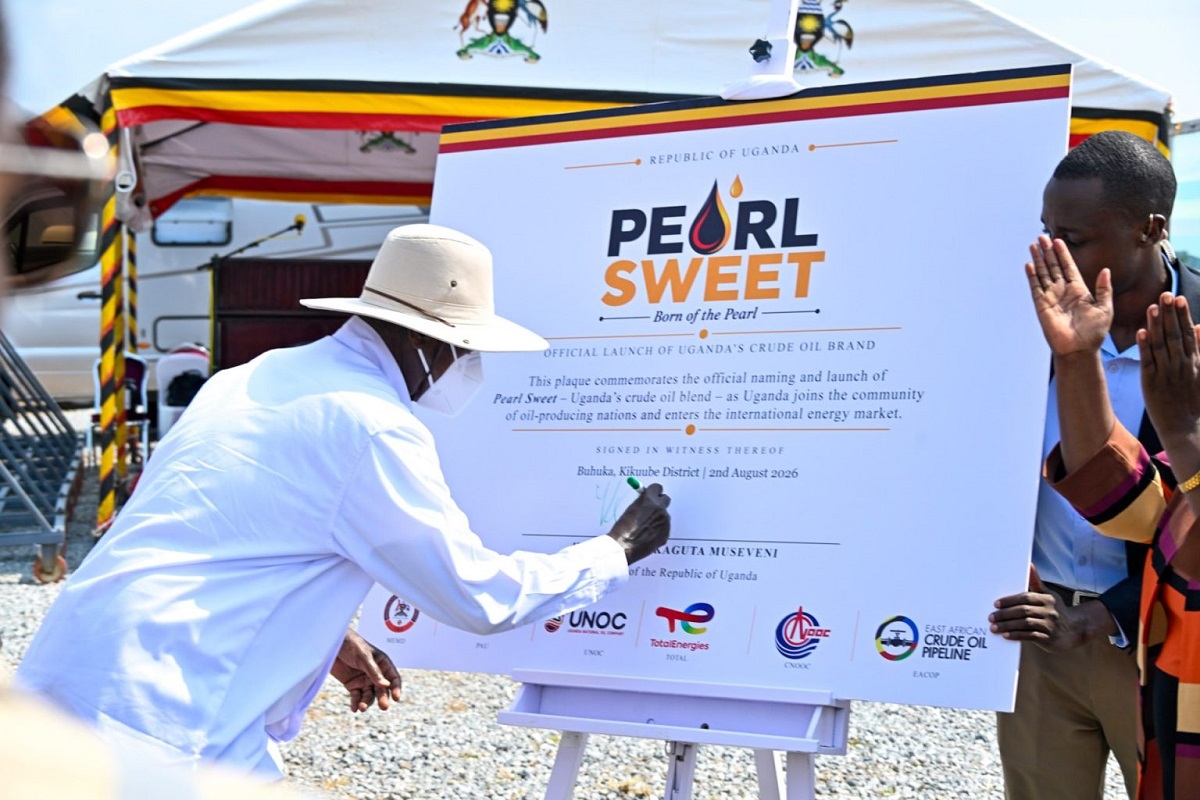
President Yoweri Museveni announced the name on Sept. 2 at a ceremony at the Kingfisher Development Area in the Albertine Graben, western Uganda, officially unveiling Pearl Sweet as the name of Uganda’s export crude oil blend during a special ceremony in the Albertine Graben.
The blend will combine output from two fields: the Tilenga development, operated by TotalEnergies, and the Kingfisher development, operated by CNOOC. The two crude streams will be mixed at the Kabaale Shared Facilities in Hoima before entering the East African Crude Oil Pipeline, or EACOP, for export through Tanzania.
Tilenga is designed to produce approximately 190,000 barrels per day at peak, while Kingfisher has a planned peak capacity of about 40,000 barrels per day, taking combined output to roughly 230,000 barrels per day. The fields are part of the Lake Albert Integrated Development, which is based on approximately 1.65 billion barrels of recoverable oil resources.
More than $12 billion has been invested to date across Tilenga, Kingfisher and EACOP, out of an estimated total development cost of $15 billion.
Uganda National Oil Company (UNOC) Chief Executive Proscovia Nabbanja said the naming was a commercial milestone.
“Pearl Sweet gives Uganda’s crude what every traded grade needs: a clear identity, a defined quality and a name the market can recognise,” Nabbanja said, adding that the naming “opens the next phase: taking Uganda’s barrels to market, building long-term relationships with refiners and traders and capturing maximum value for the country.”
UNOC said on Sept. 7 it had hired Vitol, the Geneva-headquartered commodities trader, to market Uganda’s share of the crude ahead of the planned start of exports. The appointment covers the government’s and UNOC’s allocation of Pearl Sweet crude as Uganda moves toward its first exports, expected in early 2027.
Energy and Mineral Development Minister Monica Musenero said the deal underscored the project’s progress. “Vitol’s appointment is another sign that Uganda is moving from development to delivery,” Musenero said, adding the deal would help “place this crude with the right refineries.”
Kieran Gallagher, head of Vitol Asia, said the new grade would find demand among refiners in Asia. Gallagher said Pearl Sweet was “well suited to many Asian refineries.”
Founded in Rotterdam in 1966 and now headquartered in Geneva, Vitol says it serves customers from about 40 offices worldwide and posted revenues of more than $340 billion in 2025.
Pearl Sweet is characterized as a medium-light crude with an API gravity of approximately 28 to 31 degrees and low sulfur content, according to industry publication World Oil, though other outlets have described it as medium-to-heavy with a high conversion yield. Industry sources agree the low-sulfur quality is central to the branding.
According to Top Africa News, which cited officials involved in the naming process, the name combines national identity with a commercial description: “Pearl” draws on Uganda’s historic “Pearl of Africa” identity, while “Sweet” reflects the crude’s low sulphur content.
Giving the crude a distinct commercial identity is a standard step for new exporting nations. International crude grades are traded and priced individually, and a named blend allows refiners, traders, shippers and market analysts to assess the crude, compare its quality with competing grades and gradually establish a trading and pricing history around it.
The EACOP, which will carry the crude 1,443 km (897 miles) from landlocked Uganda to Tanzania’s Indian Ocean coast, is nearing completion. The project said on Sept. 1 that construction had reached 92.7% overall completion, with first oil expected later this year.
The pipeline will carry crude to the Chongoleani marine terminal near Tanga on Tanzania’s coast, giving Uganda, which has no coastline of its own, direct access to international markets for the first time.
Oil was first discovered in Uganda’s Lake Albert basin in 2006, but repeated delays in financing, environmental permitting and regional politics pushed back the start of production for nearly two decades. The Tilenga and Kingfisher fields, together with EACOP, form the backbone of the country’s push to become a mid-sized oil exporter comparable to some of its East African neighbors.
UNOC holds a 15% stake in the upstream and pipeline ventures on behalf of the Ugandan government, alongside international partners TotalEnergies and CNOOC. The government has said oil revenue is expected to support broader public spending once exports begin, though it has not published detailed revenue projections tied to the Pearl Sweet launch.