
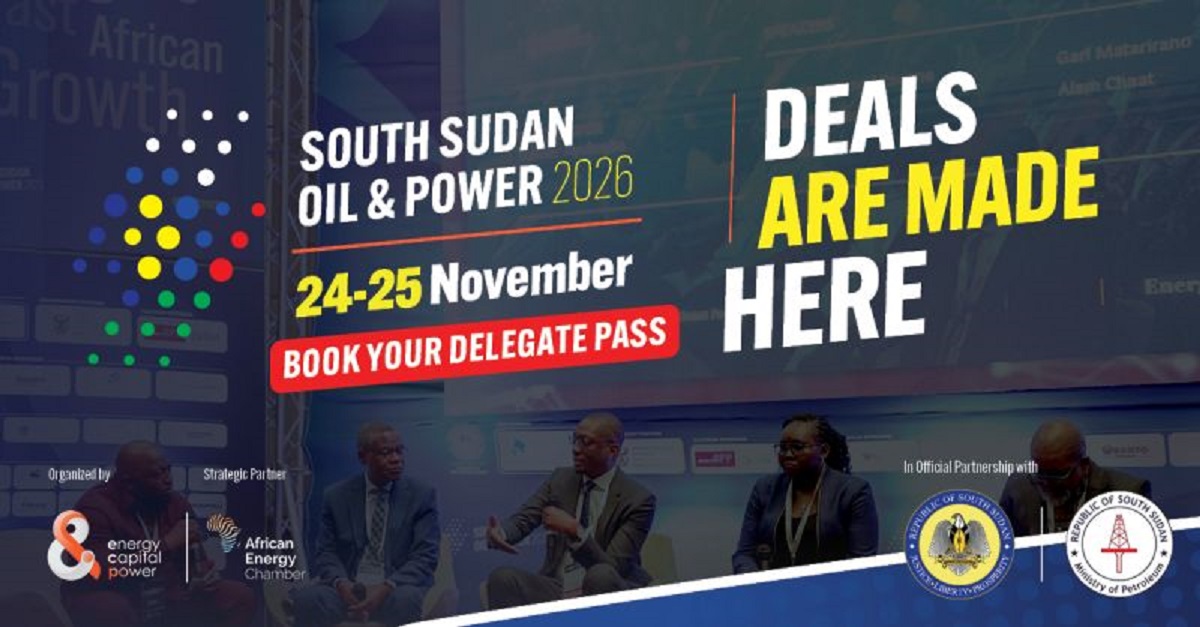
South Sudan will bring government officials, regional banks and investment firms together in Juba on November 24–25 to explore financing opportunities for its oil and gas sector as the country seeks to increase crude production and attract new capital.
The discussions will take place at the South Sudan Oil & Power (SSOP) 2026 conference, where the Ministry of Finance and Planning will join Stanbic Bank, the Trade and Development Bank (TDB) and Capium Partners to examine investment structures, financing risks and opportunities across the country’s energy industry.
The conference will focus on mobilising capital for upstream oil development, petroleum infrastructure and local energy services, according to information released by the event organisers.
Held under the theme “Resource Renaissance – Energy-Fueled Growth for a New Generation”, the seventh edition of SSOP will bring together government representatives, commercial banks, development finance institutions and investors.
Banks target financing opportunities in South Sudan
The programme will feature a panel titled “Risk to Return: Financing Bankable Energy Projects”, bringing together financial-sector representatives to discuss how investment opportunities can be converted into commercially viable projects.
Speakers include Godfrey Okolobo, chief operating officer for North East Africa and head of Export Credit Agency Finance at TDB; Maar Solomon Makuei, head of Energy and Infrastructure at Stanbic Bank; and Reec Akuak, partner at Capium Partners.
The discussions are expected to examine financing structures that can reduce investment risks, improve project bankability and expand access to capital for companies operating in the country’s petroleum industry.
Bankability refers to the ability of a project to attract financing based on its expected returns, financial structure, risks and capacity to generate sufficient cash flows.
Alam Chaat, head of Diversified Sector at Stanbic Bank, will also participate in a separate session titled “The Juba Declaration: Building East Africa’s Next Energy & Industrial Frontier”.
The session will consider the role of financial institutions, government agencies and other stakeholders in supporting regional investment partnerships and economic development.
The involvement of commercial banks and development finance institutions reflects the importance of financing beyond exploration and crude production. Oilfield operators and service providers also require working capital, equipment financing, trade finance and guarantees to support their activities.
South Sudan targets higher crude production
South Sudan’s investment drive comes as the country seeks to increase crude oil production from approximately 174,000 barrels per day to 230,000 barrels per day.
According to the SSOP organisers, the country has an estimated 3.5 billion barrels of proven oil reserves, with significant resources yet to be developed.
The country is also offering 14 exploration blocks for investment, creating opportunities for companies interested in upstream exploration and production.
Achieving the production target will require investment in existing oilfields, new exploration activities and infrastructure capable of supporting increased output.
The country is pursuing opportunities in both brownfield and greenfield developments. Brownfield projects involve expanding or improving existing oil and gas assets, while greenfield projects involve developing new facilities or exploration opportunities.
Improving production from existing fields could provide opportunities for companies offering drilling, engineering, maintenance and oilfield services. New exploration projects, meanwhile, could attract additional capital from international energy companies and specialist investors.
Infrastructure creates additional financing needs
Investment opportunities extend beyond oil exploration and production.
South Sudan also needs infrastructure to support the movement, storage, processing and export of petroleum products. These requirements create potential opportunities for investors in midstream and downstream activities.
Midstream infrastructure includes pipelines, transportation and storage facilities, while downstream activities cover refining, processing and distribution.
The SSOP discussions are expected to examine how partnerships between domestic financial institutions, regional lenders and international capital providers could support infrastructure development.
Financing requirements could include crude storage facilities, refining infrastructure, petroleum logistics and services supporting oil production.
Regional financial institutions seek investment partnerships
The participation of TDB and Stanbic Bank highlights the role regional financial institutions could play in connecting South Sudan’s energy sector with capital and financial services across East Africa.
Development finance institutions typically provide longer-term financing, guarantees and other financial instruments for projects that may face difficulties accessing conventional commercial lending.
Commercial banks, meanwhile, can support businesses through transaction banking, foreign-exchange services, trade finance and working-capital facilities.
Capium Partners’ participation adds an investment advisory perspective to discussions about structuring projects and attracting capital.
The organisers expect the conference to provide opportunities for government authorities, investors, financial institutions and project developers to establish partnerships and advance investment discussions.
The event will also feature project showcases and networking sessions intended to connect capital providers with companies and government representatives.
Oil dependence remains central to the investment agenda
South Sudan’s efforts to attract investment are closely linked to the importance of petroleum in its economy.
Increasing production and developing supporting infrastructure could strengthen the country’s capacity to generate oil revenues while creating opportunities for businesses involved in the wider energy value chain.
However, achieving these objectives will require more than access to oil reserves. Investors will need commercially sustainable projects, reliable financing arrangements and infrastructure capable of supporting production and exports.
The SSOP 2026 discussions will therefore place considerable emphasis on reducing investment risks and developing financing partnerships that can move projects from proposed opportunities to implementation.
The November 24–25 conference in Juba will provide a platform for financial institutions, government representatives and investors to discuss how that financing can be mobilised.

Indumwa
Investreet Financial publishes financial education, market insights and practical resources to help readers make more informed financial decisions.